Tuesday, January 13, 2015

Weird, Wild Yentna


Weird, Wild Yentna

Yentna River Report 1/11/15
    Roger Phillips- Deshka Landing trail Report (Facebook) Jan. 11th. -  Got home (a few miles above Northwoods Lodge) about 11:00 last night. WHAT TRAIL........Yentna river was pretty good all the way to about 2 miles below Lake Creek. THEN Overflow, Overflow and More Overflow. Flowing Water over Ice.. I am done hauling I believe, for a while.
    For some strange reason I seemed to have developed a sudden interested in hydrology.  
Heading towards
the Yentna fog.
    As we pulled onto the Yentna River the fog was winning the battle with the sunrise and it was a spectacular sight to behold.  It was time to go home. We were all packed up and ready to head back up river to the McDougal trail.  From there we would be dry-landers and the remaining forty miles would be a breeze. On Friday, a few days prior, the five mile ride down the Yentna to the cabin had been solid. The trail was essentially hard-packed snow and ice; not particularly fun, but safe.
     We were leaving now and there had been no fog at the cabin that morning.  It appeared that the fog was contained to the Yentna basin and we would soon see why.  The river-fog was making visibility poor but this didn’t turn out to be our main concern as we motored out of the mouth of Indian Creek onto the Yentna itself.   Imagine our surprise when we discovered that the Yentna had risen overnight..six inches or more was my guess!  What?
    All the low places had filled up with water as far as the eye could see.  There was standing water, grey slushy water (typical of Yentna overflow) and there was even water running over the top of the ice where the day before there had been none.
     How could the river rise so much overnight?  I thought.  It’s not like there was a major weather event like a rainstorm or a heavy dump of snow. a big dump of snow could press down on the river-ice making cracks and pushing up water from below.  The low 30’s temperatures with no precipitation whatsoever seemed like a recipe for stability to me.  
     These were all afterthoughts by the way.  What I was really thinking about was; “how the hell are we going to get over all this shit?”  
     If we couldn't make it to McDougal then we would have to retreat back to the cabin.
   “You’ve got to keep your speed up!”  Bryan was the water skipping coach.  As it turned out we had to blast over four different wet places.  Our up-river progress looked like this;  I would ride out front and stop to inspect the watery section of the trail.  I would blast across and find the best place to cross. Bryan, bringing up the rear was the skip coach and would line everyone up for a straight-line blast across the water.  “THIS HAS TO SAY 25 AT LEAST.” Bryan’s finger was tapping on mom’s speedometer.  He was shouting over the sound of the motor idling and I could hear him from the other side.
   Keep in mind that solid ice was confirmed underneath all of these splashy crossings.  Snowmachine tracks were visible under the water at two of these places and solid ice under the rest.  The worst-case scenario was that I would get to use my new winch!
     As luck would have it, we made it unscathed. We scooted over the last of the overflow taking us safely to Mcdougal.
    “At least we don’t have to worry about our snowmachines getting dirty.” I quipped.  We had splashed our way to cleanliness and now we would head down the trail crossing swamps and creeks and following seismic lines all the way back to Amber Lake where the truck was waiting for us.  Observation of note: several of the other drainages we crossed had risen in water level too.  This baffled me.  I knew that I needed more information.
     Scotland shares (roughly) the same latitude as us.  As it turns out the Scottish Environmental Protection Agency (SEPA), conducted an extensive hydrological survey of their creeks and rivers spanning from 1961 to 2008.  The Scots have undoubtedly discovered what we have; the earth is warming.  In their study they have looked at such factors as snowfall (depth), winter temperatures, and hydrology (flow rate) of their major rivers and creeks.
    “Snow can play an important part in the dynamics of river flows in catchments which extend to high elevations.  Precipitation falling as snow is stored within a catchment and generally released more slowly than run-off resulting from rain. A reduction in snowfall is likely to increase the number and magnitude of flood peaks in rivers where snow has historically been a significant water store. A combination of increased winter rainfall and higher temperatures (as forecasted
in most climate change scenarios) is likely to result in increased flood risk in some catchments.”
    Does the Yentna extend to higher catchments? Yes, I know this to be true; both the East and West fork of the Yentna flow from the snowy crags of the Alaska Range.  If my non-scientific observations over the last twenty four years of traveling the Yentna in the winter have any merit, it seems that the Yentna has historically been a significant source of snow-based water storage.  Usually the snow is super deep.  The last two years specifically, have seen the lowest snowfall accumulation that I’ve ever seen.  In addition, temperatures have been warmer and rainfall has become almost as regular as snow.
    Apparently all of these factors can cause the water level to rise greatly overnight without a major weather event, essentially without warning. Weird.  
    After years of traveling the frozen Yentna I was counting on a certain level of predictability gained through experience but from what transpired this weekend all bets are off.
Bryan, celebrating the last of the watery crossings, takes to the air
spreading his wings on his Dad's 600 switchback.  


Corey relentlessly attacking a defenseless beer can at the site
of our Iditarod camp.

Once again, we did not starve.


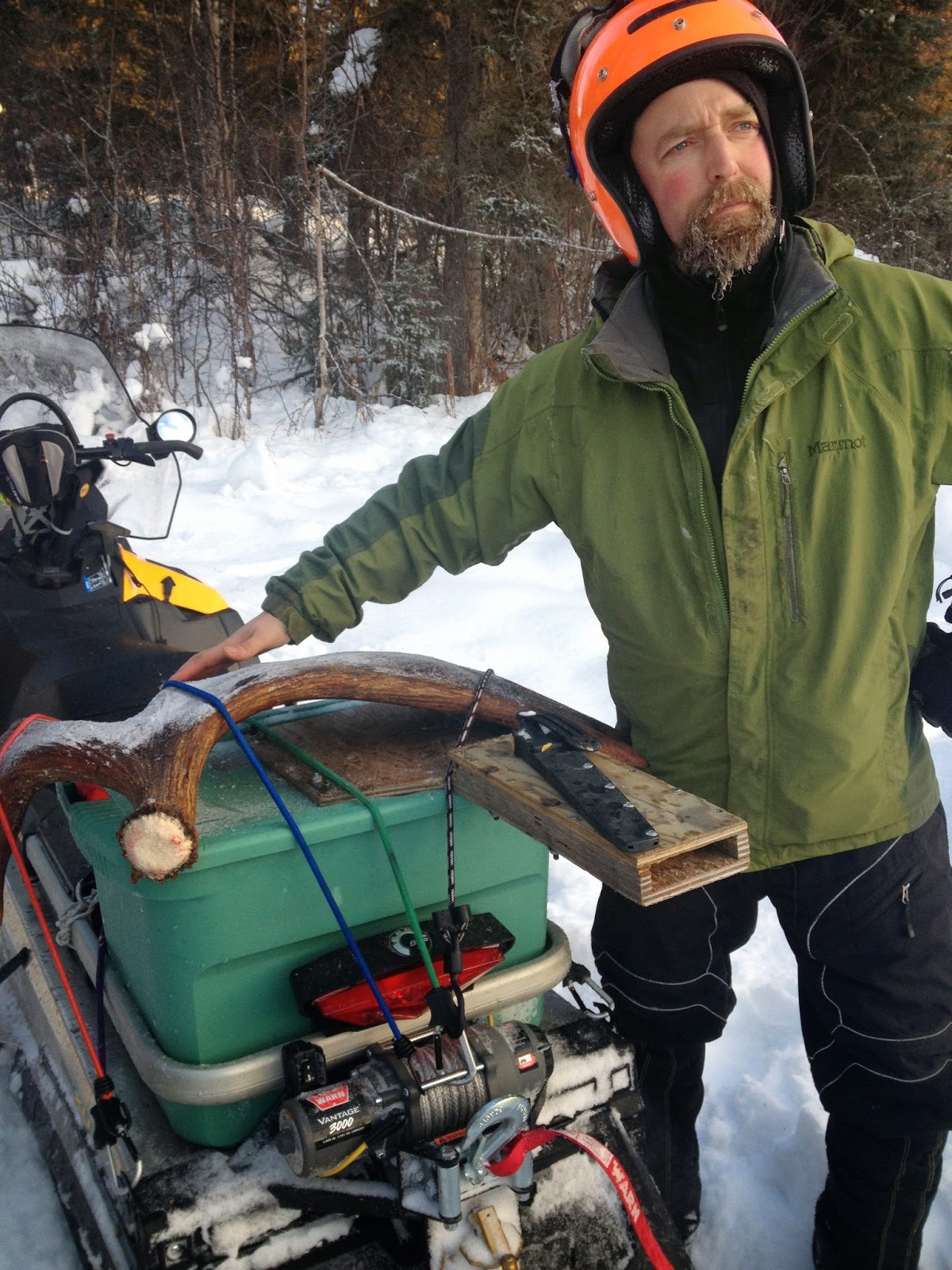
Yours truly displaying a nice moose shed, and my newly
mounted winch on the back of the superwide.


Thanks Matt Clark for capturing us at the base of a giant
erratic boulder on the way home.


You don't see this every day.  The tier 2 moose hunt was in full
swing on this weekend.  Matt Clark said it best: "Why wouldn't
you bring a sled?"  We were able to salvage a small amount of
meat off of the kill-site from a different moose.
   
Matt Clark extraordinaire.


Monday, January 5, 2015

Solid Ground


Solid Ground


Breaking the Trail Part 2

December 29th, 2014
“What’s up bub?” From what I was looking at I knew something wasn't right.  The truck was packed and snowmachines were loaded on the trailer.  Corey had on all his outergear and I had sent him out to the truck that was warming up.  By the time I had gathered the last of my things, and left the garage myself, he was lying on the ice in the middle of the driveway like a washed up beluga whale.
    “I don’t feel so good,”... shit.  I had seen a similar look from his mother during the last week.  Tamra had been fighting this same bug for quite some time and I was hoping that the rest of us wouldn’t follow suit.  All-said Corey soldiered on at least as far as the the gas station. In the end, after a few nibbles of the coveted gas station breakfast I had promised him, I took him back home.
   It would be just Mom, Dad and I this time.  We were excited to be headed back to the cabin again, the second time this winter.  The weather had been unseasonably warm but the trip in was solid.
 There was a foot of new snow and it was obvious to me that no one had been on the trail since our last trip two weeks prior.  
    Breaking trail always holds a special place in my heart.  Aside from the thought of doing-it-first (such as a first-ascent on a mountain to a much lesser degree), breaking trail is a spiritual thing.  What lies ahead?  What critters have been running here?  Are we equal to the obstacles in our path?
   The Kahiltna River was just as we had left it, but Upper Indian Creek had blown out a bit...especially after I skirted over it in Mom’s sled.  We had found a solid place to walk across. The plan was for Mom and Dad to walk over and I would shuttle the machines to the other side utilizing my take-no-prisoners approach.  
    On the first pass, with Mom’s 550, I knocked a big plate of ice free, dancing to the far bank otherwise unscathed.  We all exchanged forlorn looks after seeing the watery path I had opened up.  Nevertheless, with a careful planned launch I was able to ditch-dive the other two machines up and over the far bank.  Whoohoo!  
    Several miles later after driving over long runs of wolf tracks (they were after snowshoe hare) we popped out at McDougal and then onto the Yentna River.  It was just as we had left it with one notable exception.  As we came nearer to our turn-off spot I noticed something that stopped me in my tracks.  Two upturned snowmachine ski tips were frozen into the overflow right at our turnoff.  At first glance I thought it was a snowmachine sunk up to the skis, but upon further inspection I noticed that it was a trail groomer.  It was easy to see what happened.  Someone was grooming the trail and got caught in overflow.  The groomer was ditched altogether and bonded nicely with the river in a tight new friendship.
Wayward groomer
    Carefully and swiftly, I drove past the groomer on top of hardpan ice and found our turnoff trail.  After I confirmed its solidity I returned to collect Mom and Dad who were still trying to figure out what exactly the ghostly looking groomer was.  We pushed into the mouth of Indian Creek itself and headed up to the cabin. 
Several bends up we pulled over to inspect a recent moose kill on the creek.  Dad and I are staunch moose salvage critics and we wanted to check it out.  The hunter on this kill had done a decent job field dressing it and there wasn’t much left.  It was probably two days old and I looked around for any salvageable meat on the hide.  There were a few small hunks but the defecation of the birds prevented us from salvaging anything at all.   We saddled up and pushed onto the cabin. 
Unfortunately for our neighbor and Iditarod musher Jim Lanier the entrance to his trail was particularly soft and a portion of the creek-ice broke away as we drove over it.  Jim has been calling frequently to confirm the safety of his route so he can run his dogs to his cabin which is right next to ours.  Maybe next week Jim.
    To make matters worse, all that night through to the next morning, and all the next day it rained.  After prolonged coffee and breakfast banter we finally decked ourselves out and braved the wetness to harvest some firewood.  As we brushed out the ridge trail we were able to fill the toboggan halfway with firewood.  We are situated among old-growth forest and each year there are plenty of casualties that succumb to the will of the wind. “Let’s go over the hill,” I suggested.  I knew there was lots of dead-standing-spruce along the edges of the swamps.  Once below we would have to get the heavy sled up a formidable hill but I wanted to try out my new winch.  
SWT
   This year I bought a new snowmachine.  The Ski Doo Skandic Super Wide Track otherwise known as the SWT or simply Superwide, has quite a cult following, at least among the people of Northern Europe and interior Alaska.   Sporting the widest track on the market (24 inches) the SWT has terrific flotation and is touted as a work/utility sled.  I knew I wanted a winch on the back, which is offered as an add-on, but I wasn’t excited about paying the additional $1800 price tag for it.  I was able to order a  3000 lb Warn winch on Amazon and fabricate my own setup for a mere $350 bucks.  Not bad for a P.E teacher!  The winch pulled the 800 pound sled up the hill without hesitation.
    We were gone no more than two hours and we were completely soaked.  I think it was noon.  Needless to say, we spent a lot of down-time in the cabin that day reading, playing cards, cooking and otherwise conserving energy.  I made some fresh rolls infused with kalamata olives, sunflower seeds and freshly minced Jalapenos to go with the wonderful moose stew that had been stewing away on top of the wood stove all day long.
     Well before we crawled upstairs into our beds it was pitch black again outside and pouring rain like there was no tomorrow.  Ahhh December rain.  Tomorrow as it turned out was on our minds foremost because we had to reverse our trip on the river to get back home.  I texted Tamra earlier in the day and told her that we may have to stay an extra day or two to get back.  
   But as-is often the case, the situations we build up in our minds fall short of reality.  After coffee and a delicious specialty McMuffin sandwich laden with bacon, egg, and other accoutrements we fired up, and made our way down the trail to face our fate head-on.  “If I should die now,” I thought, “at least I have bacon in my belly.”
    As it turned out the quality of the river ice hadn’t changed as much as it had in our minds in the last couple of days.  There were long runs of pooled rainwater to blast through as we pushed up river to McDougal but nothing gave way and the trail was solid.  
    Finally we were off the river, pointed towards the truck and once again glad to be on solid ground.

Saturday, December 20, 2014


Breaking the Trail
    
The crossing at Kahiltna
The two bulls stood next to a cow and they were all staring at me. I shut off my snow machine hoping they would stay for a while. Dad pulled up alongside and shut off his sled too. Both were two year old bulls. They resembled the goofy moose in the old Rocky and Bullwinkle cartoon.  High thirties, maybe low forty inch antler spreads at best, these fellas were far from their potential as giants of the forest.  Eventually they spooked and took-off into the thicker woods away from us and our noisy engines.

     “Ready?”

    Dad gave me the thumbs-up and we were off.  Breaking the trail forty miles to our cabin had been a breeze so far.  In my mind’s-eye we had already surpassed one potentially daunting obstacle;  The Kahiltna River. It had been on my mind for several weeks:

    The Kahiltna River is a bit of an anomaly. It is a glacial river that shoots out of the Alaska Range from underneath the mighty glacier that bares the same name. At 44 miles long, the Kahiltna glacier is the longest glacier in the Alaska Range and with all the snow and ice that melts each summer, it produces a melt-off worthy of note.
 The glacier’s upper reaches see thousands of climbers each year all of them harboring dreams of high places but not many people know or care too much about the Kahiltna River itself that spills out from under it all; It has quite a nasty reputation.
There is a tale told in the age-old manuscript Conquest of Mckinley where five gold miners attempted to raft down the Kahiltna in a wooden skiff. As the story goes the boat got hung up and broke apart on a partially submerged boulder in the Kahiltna Canyon. Apparently four of the miners held-fast on the boulder for four whole days shivering and fretting,whilst the fifth figured: "Death by drowning was preferable to a living hell." Almost naked, he took to the water and by the aid of a portion of the boat which had struck the rock, he succeeded in reaching shore. In the end the daring swimmer survived, bushwacked downstream eventually discovering a trapper's cache that was his salvation. Imagine the others' incredible surprise when another miner, rowing a different skiff came barrelling down the canyon in their most dire hour. He couldn't believe his eyes upon discovering the four shivering miners clamoring to the rock. The lone miner managed to make it to shore somewhere downstream. He was able to make it back up to them and ultimately saved them by way of rope. They all survived. This was 1911.
    Flash forward 92 years. Yours truly was also involved in a failed rafting trip on said Kahiltna. We tried to negotiate these same turbulent boiling waters to no avail.  Although this is another story altogether I will say this:  After negotiating our way around house sized boulders in class five rapids with the wrong raft and virtually no experience, we flipped.  Go figure. After dragging our drowned-rat asses out of the raging torrent, we decided to hike out ten miles through the bushwhack instead.  Smart choice. Kahiltna River....one, Steve....zero.  
     Today was different, today all we wanted from the Kahiltna was a winter crossing.  Due to an unseasonably warm winter thus far it wasn’t entirely frozen yet.  A long band of swiftly running water gushed by us in a series of dancing waves; hardly the stuff of ideal snow machining. The open stretch continued downstream as far as the eye could see.  Initial thought....shit.
The Kahiltna 12/17/14
   Nonetheless, some other adventuresome soul, even antsier than myself to reach the other side,was gracious enough to do my dirty work for me.  I looked below the bank and beheld a lone snow machine track leading under the cut bank upstream to a carefully planned crossing some two hundred meters upstream.  I walked the bank to check it out.  Sure enough a few transplanted spruce branches flagged with survey tape marked the way straight across the river!
     Having overcome the crossing at Kahiltna, we were onto the the next potential problem, some ten miles down-trail;  Upper Indian.
     Upper Indian Creek (the U.I. to some) can be troublesome as well.  This slow moving frog water is cut deep into the marshes and is notorious for its unpredictable freezing patterns.  In years past it has taken a dicey jump-move to blast down and then up the other side. Luckily after some investigation, I found a suitable crossing.  After I scooted over top, Dad followed.  A few insignificant chunks of ice broke free but nothing that would undermine the integrity of the crossing for our safe return.
The U.I. gave itself to us this year
without much trouble.
An overwhelming thought overcame me; What a pleasure it is to travel in this wild country!
    Things were looking up for us but sometimes life is funny.  As it turned out the last five miles to the cabin were by-far the most difficult of the whole trip.
    We turned off the main section-line to commence trail breaking onto our very own short-cut to the cabin. This trail, cut-in three years ago allows us to avoid traveling the Yentna River altogether.  The Yentna, another major glacial river draining out of the south side of the Alaska range is loaded with potential for mishap, especially during early freeze-up. Unfortunately for us, when we brushed-out the trail originally three years ago, the snow was much deeper, so on this trip all of our prior cuts were exposed stubs of doom, jabbing at us, throwing us sideways, cursing us! Like a sea of frozen hammer handles, we surged over, around, and through them.
      After finally passing the trail of jabby sticks we made it to quite possibly the worst beaver marsh traverse ever.  Without enough snow to lay down the willows, we had to plow over and through them being careful to avoid open beaver ponds and overflow.  The terrain here was particularly demanding and rough and it was with great relief when, at last we reached Indian Creek itself. All that was left was a mile ride down the creek.
      Although each bend in the creek had open water and overflow, we decided to be nimble and swift in our movements effectively avoiding calamity or any other undue mishap.  It was nice to be moving so quickly after enduring all the dis-pleasantries of our dubious shortcut.
   We arrived at the cabin and as always we were in good cheer despite the struggle of the last few miles. We peeled off helmets and headgear revealing our sweaty heads which were throwing off considerable steam.  “Wow, that last part was rough.”  He was right, it was rough and in hindsight we should have pushed-on to the Yentna where a better trail had already been established.
    “If it were easy, then everyone would do it.”
Cabin fare:  Large, hot jalapenos stuffed with moose chorizo
and cream cheese, wrapped with moose bacon.  Pin together with
toothpics and bake until done.  Serve with a generous roll of toilet paper.
The dangers of the Yentna trail
 are mostly self-evident.
11:00 A.M. Dec 15th. Life is good.


Tuesday, November 11, 2014


Hitting Stride

"The trouble with retirement is that you never get a day off" -Abe Lemons
Steve and Rachel Harrison
     Steve and Rachel Harrison, my beloved folks of 68 and 70 respectively, are hard-at-it as usual.  Never okay with just sitting-around twiddling thumbs, they have turned into, as Dad likes to quip, “farts on a skillet.”
    Since retiring from the U.S Fish and Wildlife in 2001 with 30 years of government service, dad joined my mom who also was retiring from her own career with the Anchorage School District having taught elementary school in Eagle River for 25 years.  
    Upon retirement they relocated North from their Eagle River roots and settled into a nice spot on the bluffs of the Susitna River in Willow, Alaska.  Having fished commercially at the mouth of the Susitna and sport fished in its tributaries for years, it was a natural fit.
    Hitting-the-ground running never seemed so natural for these two retirees who during their working careers kept busy raising three children who were involved in multiple sports and dance all-the-while running a family oriented commercial fishing business in the summer-on their leave time.  
   Since their "retirement" they have become the busiest people I know.  Retirement for them hasn't been a time to slow down; it has been a catalyst for switching gears.
   What is amazing to me is that they seemed to have been able to find the perfect balance between family, recreation, and chores.  I look to them as models of the ideal retirement; if not an exact formula, here are their patterns:
   First and foremost, priority is always given to every possible grandchild's sporting event, recital, or babysitting opportunity.  They have seven grandkids, and this alone keeps them on their toes. Since two-thirds of the the immediate family still reside in Eagle River, they are constantly driving the 80 miles to watch hockey, basketball, and volleyball games and don't forget about birthdays.  They are not bothered by the drive and will make the trip at the drop of a hat.  Along with the grandkids, they have also taken to supporting their aging son’s running endeavors.
    Next, they have cleverly set themselves up with plenty of things to do, mainly in the form of cabins to maintain and improve upon. Besides their home base in Willow, they also have three other cabins strategically built in scenic wilderness locations scattered around Southcentral Alaska.  They are all incredible places in their own right, but the surrounding wilderness is the overwhelming appeal to each of them. Dad played a major role in the construction of all of these places including their house in Willow and has taken it upon himself to become the superintendent-of-projects at them all.  Every homeowner is familiar with the inherent burden of ownership.  Dad has four burdens but he doesn't see it that way.  He enjoys it.  He always has projects to do but he is good at balancing project time with fishing time. Amen.
    Mom is the chief decorator, resident artist, and artifact collector at all of their places.  She has brought her artsy style to life in them all.  She has a keen eye for regional touches and likes to collect local artifacts and nick knacks to display on shelves and window sills.  Her mosaic tile work can also be found in each of their places.  In addition, she is not afraid to voice her opinion about additions, improvements, or any other worth-while suggestions.
Mom's touch
   Their cabins are not accessible by any road; only boats or snow machines can get you there which, in-turn has provided ample maintenance opportunities for their three fully operational boats and two snow machines....you know, so they don’t get bored.  It is not uncommon for Steve and Rach to return from one cabin only to start packing for a trip to another.
    Each fall, hunting takes priority and it’s no wonder that their freezer is always full.  Dad has been a committed subsistence hunter and fisherman ever since they moved to Alaska in 1969. He has shared his passion with his two sons who pursue big game and fish each and every year.  Generally we all work together as a hunting team, processing and sharing meat.  As it turns out my folks have learned a thing or two over the years and are masters of fish and game processing. They are generous with their windfall and look forward to sharing with friends and family alike.
My mother is a case all her own and if social health were measurable, she would be pinning the needle, topping-out on  "full."  Somehow meshed with all the cabin trips, family stuff, and everything else, she manages to keep a social calendar rivaling that of Michele Obama.  Mosaic Wednesdays are a must, as-is yoga Mondays.  Don’t forget about Bunco and book club.  Did I mention the garden club? Also, it seems that her years of teaching haven't escaped her; she volunteers each year at the elementary school during art- week and she eagerly helps set up bulletin boards in my wife's classroom.
Fishing with Grandma and Grandpa

    Both Steve and Rach have been actively supporting the efforts to protect the Susitna River.  They have an extensive history of recreation, subsistence , and commercial activity on the river and have been interviewed, quoted, and consulted about their opinions on the proposed development of the Susitna-Watana Dam.  The dam, which could be quite possibly the worst idea to ever come out of Juneau, would dramatically change the river that takes them to two of their cabins and would destroy the salmon that thrive there.  Not ones to sit quiet while their wilderness livelihood is being threatened, they are doing what they can.  It is their hope that their volunteer and advocacy efforts will pay-off allowing their grandkids' grandkids to experience the same Alaska that they have become enamored with.
     Their love of Alaska is undeniable but they do manage to get out of state once or twice a year to visit friends and to otherwise scratch their travel itch.  In recent years they have enjoyed traveling with several of their former Alaskan neighbors that they have kept close contact with, and they have also reconnected with some old friends from their youth in Washington State.
 They have been known to travel with family too.  Imagine our excitement when in the summer of 2012 they surprised the whole family with Mexican Riviera cruise tickets to help them celebrate their 45th wedding anniversary.
  Several times a year the stars align and all of their children and grandchildren converge upon one location at a cabin or holiday gathering.   These are Steve and Rach's favorite times and it’s during these gatherings that it is easy to see that they are playing their cards perfectly.
The whole fam damly.
Dad carving up a beauty.

Mom taking full advantage of Pete's muscles and hip-waders.

Dad, Pete, and I doing our thing at fish camp.

Top of the world baby, top of the world.