Sunday, July 7, 2019

AWC Day 5

Day 5: Upper Fog Creek to Terrace Lake

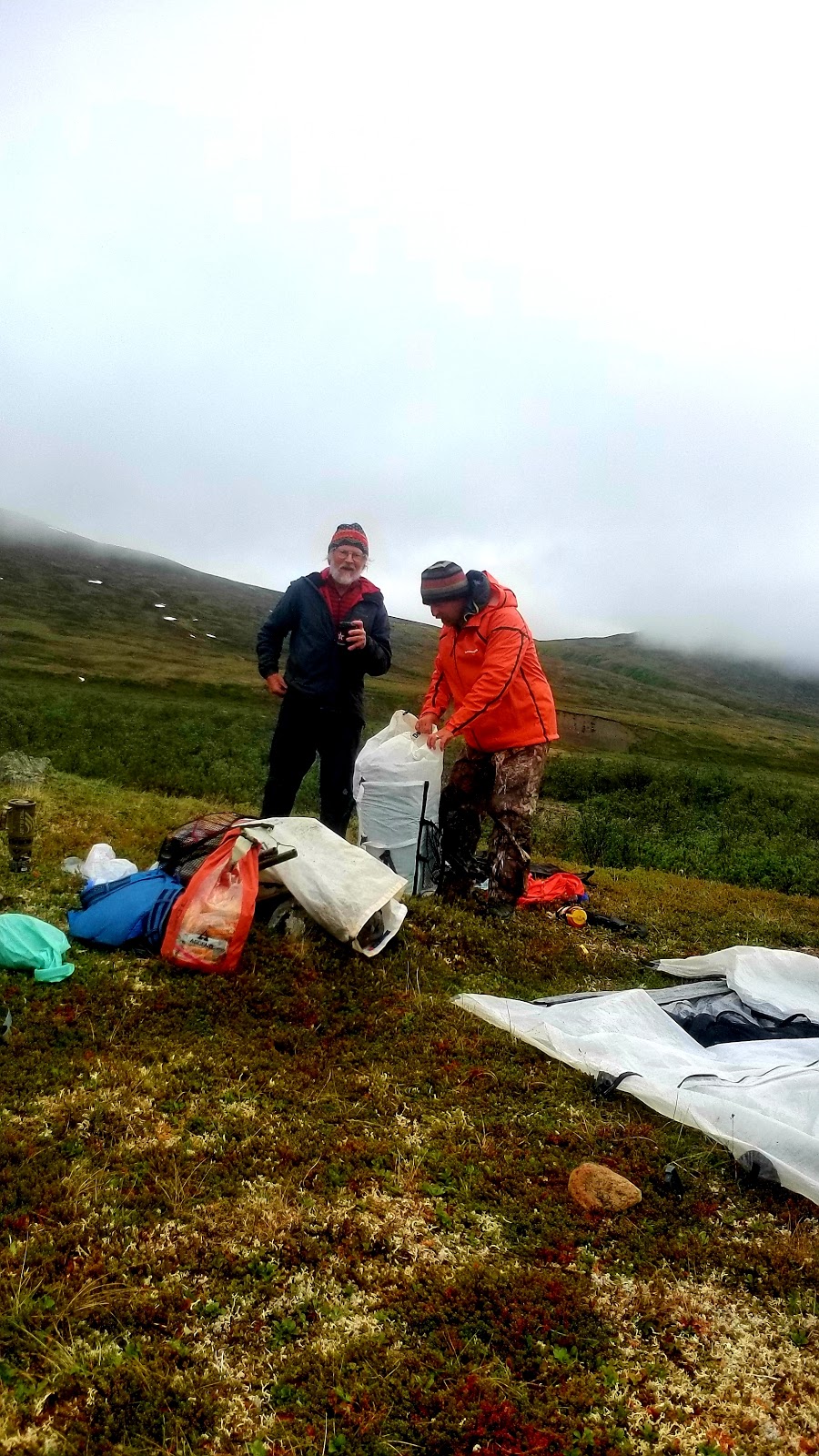
      On this morning we afforded ourselves two cups of coffee! I broke down the tent and Artie tended to his feet.  “Art, look there’s some hikers!”  Suddenly the mood in camp changed.  One at a time we watched six hikers crest a nearby ridge.  They were about a half of a mile away.  We quickly packed up and took-off down into the valley.
     “When we get below the rise, I’ll drape my raincoat over my pack so they don’t see us.”  The competitor in Art was rising to the surface and it was funny because up until then we had both forgotten about the race part of this thing.  We had no way of knowing whether any of them saw us or not. 
     After about 20 minutes of hiking I looked back and could see that they were setting up a tent.  This blew our minds.  “What are they doing?” I said.
     “Maybe they are going on a night schedule too.” said Art.  All of the possibilities swirled in our heads as we hiked towards a far distant pass. The idea that we were ahead of at least 6 competitors was invigorating.  We congratulated ourselves on our smart route finding decisions and wondered why they didn’t just do what we did. It was quite funny all of the thoughts that surfaced.  

      After crossing Fog Creek we had a 100 foot snowfield to climb.  “Hey, let’s make giant steps in the snow to throw them off.” said Art.  “They’ll think we’re really tall.”
     “Or they’ll think we’re really fast.” I said.  We must have looked pretty goofy leaping up this snowfield.  I stepped in Arties footprints to further throw off our competition into thinking that there was just one of us.  
     From the pass above the head waters of Fog Creek we descended into the Tsisi Creek valley.  The hiking was almost entirely above treeline.  From up high we plotted our course down to the creek.  “Let’s make it down to those serpentine benches.”  Art pointed across to a series of benches that linked in a curvy pattern all the way to the creek.
     We cut across a brushy valley to access the first bench.  The benches were huge (much bigger than they appeared from across the valley) and we wound our way around and down to the last bench that overlooked Tsisi Creek itself.  After crossing the creek we made our way up onto a gentle rolling plateau.  We were into the magical 4000 foot elevation where the brush gives way to low lying tundra, lichens, and fields of talus.  This great hiking would take us all the way to Terrace Creek.
     A gentle afternoon breeze had begun and grey clouds gathered in pockets around us.  Lightening flashed in the far distance.  We began counting between the flash and the thunder.  “Every 5 seconds between lightning and thunder is one mile” said Art.  There were several distinct thunderheads around us and it was hard to see all of the flashes.  The rain began and we stopped to put on our raincoats.  From the corner of my eye,  I saw a flash to our West and began counting. 
    “One…” BOOOOM! The Thunder shook us to the core.  We decided to sit down and chill out for a while.  Soon we could see that the wind was blowing the thunderheads across Tsisi valley and we continued along the rolling plateau no worse-for-wear.  
     In the far distance to our Northeast, on the other side of the Susitna River we could see what looked like a small fire started from the lightening.  A small narrow smoke stack rose into the air.  We hoped that the accompanying rain would mitigate the situation.   
     It was late in the day now and we were in what I call marching-mode.  Our feet and legs would start to ache, we were getting tired and so we did what Dick Griffith told us to do; “Just put one foot in front of the other.” he said.  We must have been zoning-out because we neglected to check our bearings with map and compass or my GPS.  By the time we came upon the steep canyon leading down to Terrace Creek we were three miles off of our route.  It was at the end of the day and we decided to camp overlooking Terrace lake.  It was an amazing view.  There were several high alpine lakes at the end of the valley that spilled into lower ones finally gathering at Terrace Lake at the bottome of the valley.  From there Terrace Creek drained out of the North side of the lake and made its way towards the Susitna.
     We took out the map, figured out our mistake and plotted our correction route for the next morning. “Oh well, at least we get to check out Terrace Lake,” said Art.  It was an amazing view right in front of us, something from a postcard;  This would be our Terrace Lake camp.
Terrace Lake camp.  The plateau in the upper right of the photo contains several high alpine lakes.
They all spill down into Terrace Lake

Saturday, July 6, 2019

AWC Day 4

Day 4:  Susitna River to Upper Fog Creek
What a find!

     "You ready?" I asked.
      "Tally-Ho." He said, and with that we were off.  At the start of our fourth day of 11 plus hours of continuous hiking we were starting to hit our stride.  Our pacing was well matched and we would trade the lead often.  When one of us  was leading the follower could relax a bit and just follow.  Sometimes leading through bushy country can be mentally draining; You are always searching for the “right” way.  
   Within a mile of leaving Deadman camp we spotted a giant caribou rack.  Both antlers were still attached to the skull.  It was obvious that this ol' boy died not long after the rut.  We were seeing a lot of caribou sheds now most of which were very small and reminded me of the one the Grinch tied onto his dog and then cut down-to-size with a saw.  We established a habit of tapping each one we passed-by.  By the time this journey was through we had tapped hundreds of antlers.  
    Before descending into the Susitna Canyon we crossed a huge flat area carpeted with low lying tundra. It was a joy to walk on and as it angled towards the Susitna and we knew that our easy walking was probably coming to an end.
     
Rocky outcropping before dropping into the Susitna
drainage; lovely hiking by anyone's standards.
Imagine our surprise when we discovered that the descent to the river was not only easy but amazingly beautify. We snaked our way down through stands of spruce and fields of ferns. We climbed over rocky outcroppings laden with wildflowers of white and purple and yellow.  The aromatics of the summer's full plumage were intoxicating and familiar as we picked our way down, down, and down until finally we popped out onto the Susitna that was glowing in the sunshine below us.  
Descending to the Susitna.

    We were happy to discover that the river was very mellow at this point.  It was hard to believe that just 15 miles below us was the beginning of Devil’s Canyon, a class V juggernaut.  We leisurely inflated our rafts, took off our shirts, and hiked up a little way upstream.  From there we ferried across the mighty Su.  The other side of the river looked steep and thick with foliage and we knew that it would be a battle to overcome.
   
Nice work Artie!
“Okay Steve, lead the way.” Art said.  We were all packed up and ready to tackle this hill.  I made my way off the beach and grabbed the first alder to move it out of the way.  I couldn’t believe my eyes when I noticed that right in front of me was a caribou super-highway leading straight up the hill.  We followed it up the first pitch and could see that it kept going. As luck-would-have-it we were able to ride it out right to the top.  It was an amazing windfall and we couldn’t believe our luck.  I imagined that if our trail was so easy to find there were probably many such trails all along the area that the Nelchina caribou herd use each year.  It was a wonderful climb up and off of the Susitna River. 
Topping out of the Susitna Canyon.

     “You know that we would be under water right now if the Susitna Watana Dam was in place.”  I looked below at Arthur and to the river below and couldn’t imagine such a thing.  The dam project, one of the worst ideas to ever come out of Juneau would decimate the salmon runs.  I know this because every other dam of this magnitude has done exactly so.   As we crested the top of the canyon I couldn’t help but ponder the future of the Susitna River. 
     After topping out of the canyon our route led us through some less favorable terrain.  We made our way through spongy swamps scattered with dwarf spruce.  It was miserably hot and by the time we got to the Fog Lakes we were bushed (no pun intended.)  We decided to pitch the tent in the shade, sleep for a while and possibly take-up a night schedule.  We had both done this on Denali and if this weather pattern held, it would be a smart move. We slept for a few hours, packed up and headed up the hill.
     We made steady progress up to a high point several hundred vertical feet above the Fog lakes.  Finally we topped out and could identify the next pass that would keep us on our route.  From there we would pick our way up the valley through the headwaters of upper Fog Creek. 
      Near the pass we encountered a small stand of perfectly formed dwarf spruce; They were like Christmas trees.  Their shape was perfectly formed triangles and made them appear like full sized spruce trees that were much further away.  It was weird when we got close to discover that they weren’t far away, they were just really small. For some reason I couldn’t get the Wizard of Oz’s Munchkin classic “We represent the lollipop guild” jingle out of my mind; I’m weird, I know.
     We set up camp in a wide saddle of the upper Fog Creek drainage.  From here we could clearly see our route and it was glorious.   This would be considered Upper Fog Creek camp. 
     

Friday, July 5, 2019

AWC Day 3


Day 3:  Tsusena Butte to lower Deadman
High point overlooking Tsusena Butte and lake.

     We awoke the next morning feeling a little stiff.  I nixed my long standing policy of avoiding ibuprofen and before long I was pain-free; amazing stuff!  Arthur had developed blisters on his heels and would have to deal with them as they worsened throughout the trip.  It was a glorious new day and the sun was shining.  We slowly packed up camp, drank our Starbucks french roast coffee and ate some delicious dehydrated bananas that Art made at home.  Before long we were off through the thicket searching for good ground to advance our efforts.  

     The day’s hiking started out pretty rough.  Game trails were scattered and all led downhill to the bogs.  We had no choice but to suck-it-up and do what the good lord put Arthur on this Earth to do: Bushwack.  
     Reflecting back on this trip I can say that for the most part we were very well matched as far as hiking speed.  We would often trade off leading and there weren't many times when the other would get too far ahead.  The one exception was when Art was in the lead through the tangle.  18 years my senior, he turned 65 on our trip and he is a sight to behold in the bushes.  The true Alder Whisperer, he would blow through the thrash like a gentle breeze.  Often I was stumbling behind with my pack caught on a low-hanging alder struggling and sweating and Arthur would be gliding onto the next grove of gnarly entanglement with a hop in his step and a song in his heart.  
     We considered a classification system for bushwhacking alders: Mild scrambling and walking around most of the alders would be “A1”  Some crawling over/under would be “A2”.  Sustained climbing/crawling is “A3”  Long uninterrupted sections of A3 over uneven terrain including creek crossings with no end in sight would be “A4.”  
     After negotiating several sections of A3+ we finally climbed out of it to a beautiful high spot overlooking Tsusena Butte, and Tsusena Butte lake.  From this vantage point we could see where we had come from and where we were going.   “Hey there’s a lodge down there,” I said. Sure enough, on the Northwest end of the lake was a large cabin with several outbuildings, floating dock, and some sort of antiquated track vehicle.
      It took us a couple of hours to make our way down to the lake that included descending a steep ravine and crossing a large swamp.  Swamp crossings can be dubious affairs.  It’s never clear what is beneath as you commit to a step.  I’m especially leery when a step causes a jello-like ripple in the surrounding bog.  It’s all fun and games until someone slides down into the swamp of sadness like the horse in “The Never Ending Story.” (look it up)
A bog of eternal despair

      After successfully traversing the bog we had a nice walk down-to and along the lake.  Some small trout or grayling were rising off-shore making me pine for my fly rod.  Fresh fish in camp would have been a welcome addition to any of our freeze dried meals.  We came to the end of the lake where it necked down to a couple hundred feet before opening back up into another lobe of the lake.  We decided to raft across this section instead of walking all the way around the other side of the lake.  I inflated my raft and made three trips ferrying our whole kit to the other side.  On my first return trip I slipped on a rock getting back into the boat and fell in the lake.  It was a nice day and it felt good.  It must have been hilarious to watch it happen.  I wish Art would have got it on video!  From there we ascended a series of knobs that overlooked the Deadman Creek drainage.  We picked our way down into the valley below where we scared up two young bull moose that were probably twins.  Their dark velvet antlers were no bigger than frying pans; Surprisingly these were the first moose we’d seen on the trip.  
     We picked our way towards the creek and soon enough we could hear the roar of the water.  Much like Tsusena, Deadman Creek was a raging torrent.  from Google Earth we couldn’t tell whether or not it was ford-able, raft-able, or altogether impassable.  We decided to hike downstream to see if it settled down.  A half a mile or so downriver we discovered a great section to cross in our rafts.  It was a hundred yard mellow stretch sandwiched between a couple of rowdy sections above and below.  Our task was to inflate our rafts and paddle across to the other side before being flushed into the rapids below.  
Safely across Deadman, Art looks below where
the creek was less forgiving. 

     The move was well within our wheelhouse and before long we were high- fiving each other safely on the other side.  “Hey Art, can we say we pack rafted Deadman?”
     “Absolutely.” He said.  
     We packed up our stuff and continued what would be an easy ramble downhill towards our next obstacle, the Susitna River.  We made it to within four miles of the Big Su and decided to stop for the day; 12 hours was enough for today. 
     I have an intimate connection with the Susitna River and I was excited to check out a part of it I'd never seen.  We made camp on a high spot with a few nice spruce trees near what Art called a "babbling brook."  I had Chili mac Mountain House and Artie had beef stroganoff; Life couldn't be better.  We sat together on the soft moss overlooking the creek.  Art was fishing his next bite out of his dinner pouch. 
     "I can't believe we still haven't seen any caribou." I said. Although we'd spent 75% of our time walking on their trails and had discovered tons of their antler sheds it was puzzling to me as well.  We surmised that during the summer the Nelchina Herd must be closer to the Glenn highway side of their range.  
     It was another great day of sustained hiking through untouched country.  This would become known as Deadman camp.

AWC Day 2


Day 2:  The Tsusena
Art at "Woods camp"

      The anticipation of walking over the next mountain pass to discover a new valley is the stuff of Christmas morning. Although I had scouted this valley extensively from the comforts of my living room with coffee and laptop (Google Earth,) the reality of discovering it on foot pales in comparison. Most notably, the scale of how big these valleys, mountains and rivers is really hard to gauge from home.  
      The low angle pass was an easy ridge walk along meandering benches.  The caribou trails we were on could have been single track mountain bike trails.  There was a small lake at the pass with four harlequin ducks swimming, diving, and carrying-on.  We stopped for lunch and watched the ducks do their thing. 
     “Hey Artie, try some of this.”  I handed him some moose jerky that I had made for the trip.  It was a recipe I got from my buddy Bryan.  We shared food everyday; the variety was nice.
     We made our way down and out of the pass into the headwaters of Tsusena Creek. We had hoped to be able to packraft some of it and take-out before Tsusena Butte eleven miles downstream.  Below the Butte is a 120 foot water fall.  Roman Dial and Forrest McCarthy, a couple of pros by anyone’s standards floated it several years ago and classified the Tsusena as sustained class 2+ with sections of class 3 with some “spicy” sections.  As we made our way along the Tsusena it was easy to see that we would not be pack rafting unless it settled down considerably.  Long wave trains of five foot waves took turns with a few holes and haystacks sprinkled in for fun. 
     On our rookie application we declared that we were both comfortable with class 3 whitewater but unwilling to take unnecessary chances in such a remote setting. We brought drysuits but did not bring life jackets or helmets.   All sections that we saw were within our capabilities and looked like fun but we both agreed that it would be prudent to hike out.  
      After one particularly harrowing stream crossing, we made our way down to the valley below.  From here we would work our way on-top-of and around some high knobs, picking our way through the brush to areas of better hiking.  We found several moose sheds in this area including a full set from a large mid 50’s inch bull.  We checked in on the Tsusena several more times and agreed that we made the right decision.  
     The bushwhacking was getting real at this point and I wondered if it were indicative of what was to come lower in the valley.  I found a game trail that ran along the bottom of the last knob and as we followed it the trail got better and better.  Soon the trail swung towards the river and for three solid miles we walked on the most beautiful game trail that I’ve ever seen.  We tried not to jinx ourselves by talking about it too much, but I couldn’t help it.  “This is like a trail in a National Park!”  The path meandered through a healthy spruce forest along the clear and fast Tsusena.  It was a beautiful sunny day and the hiking was excellent.  
       All good thing must come to an end and sure enough our dream trail eventually led us into what we would come-to-know-as the bog of eternal despair.  At one point after sloshing through beaver choked lowlands we encountered a rather lively stream rushing before us.  The water was thigh deep and the volume and speed of it combined with the fact the the bowling bowl sized boulders were slimy. The banks were packed with gnarly bushes and it was the first time that we found ourselves fording a stream and bushwacking at the same time.  
     Finally we made it to higher ground but it was slow going again.  We followed a game trail to the top of a hill.  “Whoa, look at this.”  The entire hilltop was ripped apart and littered with bones.  It was as if a bulldozer had worked over the area.  I had seen this before and knew that it was where a bear buried a moose carcass.  Art took the jaw and jabbed it into the dirt straight up-and-down to serve as a marker.  We were ahead of at least 2 people at this point and anyone passing this spot would surely notice it.  It was our little way of saying Hi.
      We zigzagged our way down the valley searching for game trails for another hour or so before calling it a day.  It was another 11 hour day of hiking and we were tired.  Our camp wasn’t ideal but we made it as homey as we could.  This would be what we would call our “Woods Camp.”

Wednesday, July 3, 2019

AWC day 1

Day One; Jack River to Caribou Pass
Jack River valley.

      From the Denali Highway, the trail cut straight across the valley to the Jack River drainage.  Cut-in by years of four wheelers use, the trail pushed over benches laden with buck birch and other low-lying tundra scrub.   I was suppressing my giddiness as we hiked along.  After months of planning and speculation, at last the damn thing was finally playing out right before my eyes; sweet baby Jesus!
     Before long It was obvious that we settled into last place.  The “gunners” were long gone and suddenly as if it were planned, we were pretty much on our own.  
     Gunners are the fast guys that try to win.  Our packs weighed in at 44 pounds at the start. 
My whole kit.
Gunner's packs are less than half of that.  These guys can’t be troubled with such luxuries as tents, sleeping bags, or cook stoves.  If you are young, fit, and savvy enough you might have what it takes to be a gunner in the Alaska Wilderness Classic. We were self-declared non-gunners.  As our journey unfolded we would occasionally discover gunner tracks as our paths criss-crossed along the way. 

     “Hey this is going to be like the tortoise and the hare!” I told Art as we headed up the valley.  “Slow and steady wins the race.” I declared.  We chuckled about the the idea of winning.  We recognized early on that we were among elite endurance athletes.  Among the field were decorated collegiate athletes, NorthFace sponsored explorers, and other young whippersnappers that had things to prove.
     Our motivations were different.  For me the Alaska Wilderness Classic was a great excuse to check-out the wild country in my back yard. Neither Arthur or myself ever harbored any illusions of winning or placing.  In fact we weren’t even sure we could finish the thing so we took time to identify several “bail-out” locations along-the-way where fixed wing planes could pick us up.  
     After eight miles or so it was time to cross the river.  We could see the trail continued on the other side.  The volume of water was high and it was moving along swiftly.   I went first and made it past the deepest part but slipped and fell in, banging my knee on a rock.  Art struggled against the pushy current, but made it across unscathed “That was the hardest river crossing I’ve ever done,”  Art said. 
     A few miles further up the valley and we were surprised to find some horses.  A grove of cottonwood trees near the river was an idyllic setting and provided shade for eight beautiful horses of various sizes and colors.  They were all meticulously groomed, saddled and tethered to trees.  There was no one around and we figured that maybe the owners had gone for a hike.  
     “Don’t even think about it Art.” I joked.  The thought of saddling up and riding up-valley in style put a smile on our faces but it was out of the question; we didn’t have our cowboy hats. 

    Eventually the ATV trail ran its course and we were on our own to find our way up the valley.  As the day progressed the river was was squeezed into a canyon and we found ourselves weaving back and forth across the river.  As the canyon walls became more pronounced we decided to climb out and sidehill our way around the corner into Caribou Pass.  “Hey look down there?” I said. Art took out his camera that was equipped with a small telephoto lens.  Upon inspection we could clearly see that down in the canyon below was a late 80’s Arctic Cat snowmachine nestled into the bushes. There was a story there but we were on a mission and could only surmise the misadventure that led to an abandoned sled so remote. 
     We were well above tree line by now and although it had started raining, the view was amazing.  We could clearly see all of Caribou Pass to our North and the pass that would lead us into the headwaters of the Tsusena River to our South.  After 11 hours of hiking we agreed to stop and make camp.  Here we would establish camp routines that we would continue throughout our journey
     “I can't believe we are doing this” Art said.
    “Yeah, it's good to get day one under our belt.” I said.  
Camp One.
Art, Nora, and Clair.

Saturday, June 29, 2019

A Prelude to an Adventure....
Arthur Mannix and I with 44 pound packs at the start.

“Steve...
       I've never been able to "afford" the time to do a Wilderness Classic. This year, it's running from Cantwell (Jack river) to Sheep Mountain. I'm thinking of possibly giving it a try this year. Might you be interested?
-Arthur”
     The Email slapped me across the face; Was I interested, he asked?  I hit send on my reply no more than one minute after reading it.
     Yes I am interested.  Thanks for thinking of me.  Let’s get together and talk about it.  Happy Holidays.”
     The Alaska Wilderness Classic has been around since 1982.  The original race from Hope to Homer spawned the stuff of legends.  The Classic, as it is known, is steeped in folklore, at least for me.  I’ve been paying attention.  As someone who has been leaning towards this type of wilderness exploration, I have been inspired by the tales of adventure played out by some of Alaska’s heartiest souls.  Snippets of these tales can be found scattered on the internet but it’s never the whole story.       
     As-the-crow-flies from the start at the Jack River trailhead to Sheep Mountain lodge on the Glenn Highway it is 114 miles.  “How long would our route be?” I wondered. 
      The rules of the Classic are as follows: 
1) Participants must be 18 years of age.
2) Participants may share food, gear, and repairs among themselves.
 3) Roadways are off-limits
 4) Collapsed, abandoned, and public-use cabins are allowed.
 5)  Trespassing on private property or use of any locked cabins and  removal of food or gear from cabins is not allowed.
 6)  Any participant dropping out before the finish must leave a message with the in-town contact.
 7) Rescues cannot be promised or offered. 
 8) Functioning satellite phones or inReach devices must be carried by all teams.
 9)  All travel must be self-propelled, without electric or motorized vehicles or animals.
    10)  All travel must be self-contained; caches are not allowed. Littering or abandoning gear is not allowed. Observe burn bans if in place.
  
     The months and weeks leading up to the challenge were filled with Emails and discussions about gear, food, and weight.  We did our research on gear, food, and planned a detailed route using Google Earth Pro.
      “I think I’ve reached the perfect balance between excitement and scared.”  Arthur’s honesty was refreshing and I realized that I felt the same.  We were driving into Anchorage for the pre-race dinner at Dick Griffith’s house.  We were honored to meet Dick, who is 92 years old and is considered by many to be the Godfather of packrafting and long distance trekking in Alaska.  He was gracious enough to cook up a large pot of bean soup and a huge salad for everyone.  I gave him some smoked salmon. We got to meet the other competitors and share information about our routes.  Interestingly, no two groups would choose the same route. 
     We said our goodbyes, headed back to Talkeetna and prepared ourselves mentally for the journey ahead.  Arthur, his wife Karen and friend Nancy picked me up the next day and we set off for Cantwell.  Karen and Nancy would camp with us in Cantwell and see us off at the start the next morning.  They had an adventure of their own to look forward to.  They planned to hike up and over Kasugi Ridge and packraft back to Talkeetna, a trip Art and I did last November.  We were grateful for their support and wished them well on their own journey. 
     The Classic was supposed to start at 9:30AM.  At 9:45 Matthew, the event organizer, nonchalantly announced, “ Ok, I guess we should probably start this thing.”  We all gathered for a group photo.  Afterwords Matt took his trekking pole and scratched a crude start line in the gravel parking lot.  I followed suit by drawing the words “START.”  Michael Martin, a 20 year veteran of the Wilderness Classic raised a flare gun, shot it high into the air.  Many of us stood there watching the flare as it crackled and arched back down to the ground, landing softly on someone’s SUV.  
     “A journey of a thousand miles begins with the first step.” I said as we walked off of the Denali highway onto the trail that would lead us into what would turn out to be some of the wildest country I’ve ever seen.  
Hearty souls.


Thursday, February 28, 2019

RMK Recon

RMK Recon

“Two men enter, one man leaves”-  Mad Max Beyond the Thunderdome.

     We might as well have been in the Thunderdome that day when we set out on RMKs.  Strikingly similar, our predicament was only slightly different;  Two sleds enter, one sled leaves. 
     Mountain sleds such as the Polaris RMKs are wonderful vehicles of wintertime joy.  They can take you to wilderness that you cannot access in any other practical manner other than by way of helicopter.  Along with this joy and freedom comes a notorious propensity for getting folks into places they have no business being in.         
     Alas, we were just trying to connect the dots.  Over coffee we had noticed a potential shortcut on Google Earth that would cut-off 7 or 8 miles en route to our cabin in Yentna country.  So a few weeks ago we agreed to backtrack from the cabin on our skandic super wide tracks to explored this potential new route from the West side over to the Kahiltna River.  Upon arrival we were dismayed to discover that the river was flowing through a formidable canyon at this point and as we peered at the rapids some 400 vertical feet below we felt our hopes dash before our eyes.  Before we left the scene we found a different vantage point and noticed an inside bend on the other side of the river that was of gentler terrain. In addition there were sections of the river near there that had frozen over completely begging to be crossed; “There’s still hope,” I thought. 
End of the line.

     “Hey I have an idea,” I said to Bryan at school a few days later.  There was a small conversational pause that hung in the air; Bryan and I have been palling around long enough to be able to read each other’s tones and I’m sure Bryan was probably thinking something like: “Oh boy here it comes.
      I finished my thought with enthusiasm. “Let’s bust out the RMKs this weekend and see if we can connect the dots from this side!”  I was pretty excited about the prospect of riding my 800 RMK, a far more powerful and nimble sled than the superwides.  Intel from our first attempt wasn’t promising on completing the through-trail but how would we know for sure unless we tried a little harder? The proposed exploratory mission would tell us for sure and it was the perfect excuse to get out and do some brapping .  For those unaware, the word brap is a primitive onomatopoeia used to replicate the sound of two stroke engine winding up.  The ample snowpack had settled down and conditions were prime for a good romp through the deep powder.
     “Okay.” he said.  It’s not hard to talk Bryan into stuff, at least for now.
     The ride-in was just as magical as we hoped it would be. Deep fluffy snow cushioned our every move as we carved, jumped and otherwise brapped our way through miles of wild, beautiful country.  Untouched rolling swamps took us past glacial erratics topped with sprouting black spruce trees.
Erratic sprouting spruce hair.
   After linking several more swamps we came upon our first major obstacle.  It was a valley that descended 200 vertical feet to a creek and swamp below.  Overcoming it involved carefully picking our way down a steep hill riddled with alder patches, crossing the swamp then finding a way to blast up the other side.  Luckily we discovered an old cat trail on the other side that took us nicely to the top.  We were surprised to find an old 1000 gallon fuel tank sitting at the top. 

      The Kahilta, however remote and wild has been the object of exploratory mining since the early 1900’s.  This tank of fuel was most likely part of someones mining plans at some point. “You good on fuel?” I said as I pointed to the giant tank that was protected somewhat by a few large mystery panels.
Fuel anyone?

     We continued along an old seismic line stopping a few times to look at the GPS on Bryan’s phone.  Finally we could see the topography in front of us start to drop.  Before us lie the crux move of our connect-the-dots route: The Kahiltna gorge.
   As I nosed my 800 RMK downwards I proceed only because I had confidence in our ability to ride our way back up these formidable hills even if it took a few tries to do so.  The 2.5 inch lugs on our tracks coupled with ridiculous horsepower enable these machines to swim through the deepest of powder, overflow and even water.   They are no-doubt incredible machines. 
2.5 in paddle track on the
800 RMK

     As amazing as they are, these machines operate in a mechanical world that is imperfect at best and can be at-times unforgiving. With this being said,  I can say that I wasn’t too surprised when Bryan’s sled shit-the-bed near the bottom of the last hill of the canyon that we had fought so hard to climb ourselves down into. Interesting.
     We were less than 300 feet from the Kahiltna River itself and only 1000 feet from the GPS point completing our connect-the-dots route on the other side of the river. 
     Ironically the problem with Bryan’s sled turned out to be the same thing that stranded me at the cabin a few years back. The voltage regulator had failed causing a loss of all electronics.  If it was just a matter of losing the lights and gauges it wouldn’t be a big deal but since the engine is fueled by electronic fuel ignition it proved to be a show stopper.  Bryan tried new plugs. Nothing.  Finally after letting it set for a while we could get it started but it wouldn’t rev high enough to spin the track.  We spent over an hour troubleshooting it.  I peered over the final bench and could see the dancing water of the Kahiltna coursing through the canyon.  
     “Do we have reception here?” I asked.  Bryan checked his phone.
     “No.” I was hoping that we could contact Don, the head mechanic at Hatchers Pass Polaris to see if he had any thoughts on the matter.  
White lightning has seen
better days.

     “Well, I think we should start making our way back,” I said.  Bryan knew that we couldn’t spend all day trying to fix it.  We were about 20 miles from the truck and if we waited too long we would be in the dark.  It was unclear how long it would take us to scratch our way back out of this rugged country.  We agreed on a plan of action to get both of us back to the truck on one snowmachine.  Bryan grabbed a few things off of his sled.  
     I blasted up the first steep bench in our down tracks and Bryan started crawling up the hill on all-fours behind me.  The trail was too new for the snow to be work-hardened enough to stand on.  Every step would punch the hiker through the trail.  A crawling technique dispersing the hikers weight turned out to be a better plan, at least on the uphills. 
     So went the progress; crawl up the hills, ride double on the flats...lather, rinse, repeat.  We traded off a few times.  It was arduously slow and uncomfortable riding double but before long we made it up to the swamps which were comparatively flat and therefore easier.  Luckily I have a small cooler that fits perfectly on my aluminum gas can rack. Before we left I stuffed it full with extra clothes, food and supplies.   This cooler worked as an auxiliary seat and proved its weight in gold and supported Bryan all the way back to the truck.  
     When we finally got back we were chilled because we had gotten sweaty and it felt a little bit like the scene in Dumb and Dumber when Lloyd and Harry are frozen to each other on the back of the scooter. On the way back home in the truck we formulated a detailed plan to recover Bryan’s RMK.  We would return the next day with our superwides (outfitted with winches), Bryan’s dad Ernie, and new attitudes. 


Our predicament couldn't have been worse than this.
We found a submerged dozer on the way.  Bad omen?I tried to drive
it out but it wouldn't budge.


Look how close we were. Blue is our normal route to the cabin.  We were so close to
connecting orange and green.
Superwides with winches help tremendously in situations
like this.
Hauling white lightning back to civilization