Thursday, September 27, 2018

Establishing Camp


    Establishing Camp


“There is no success without hardship”-Sophocles
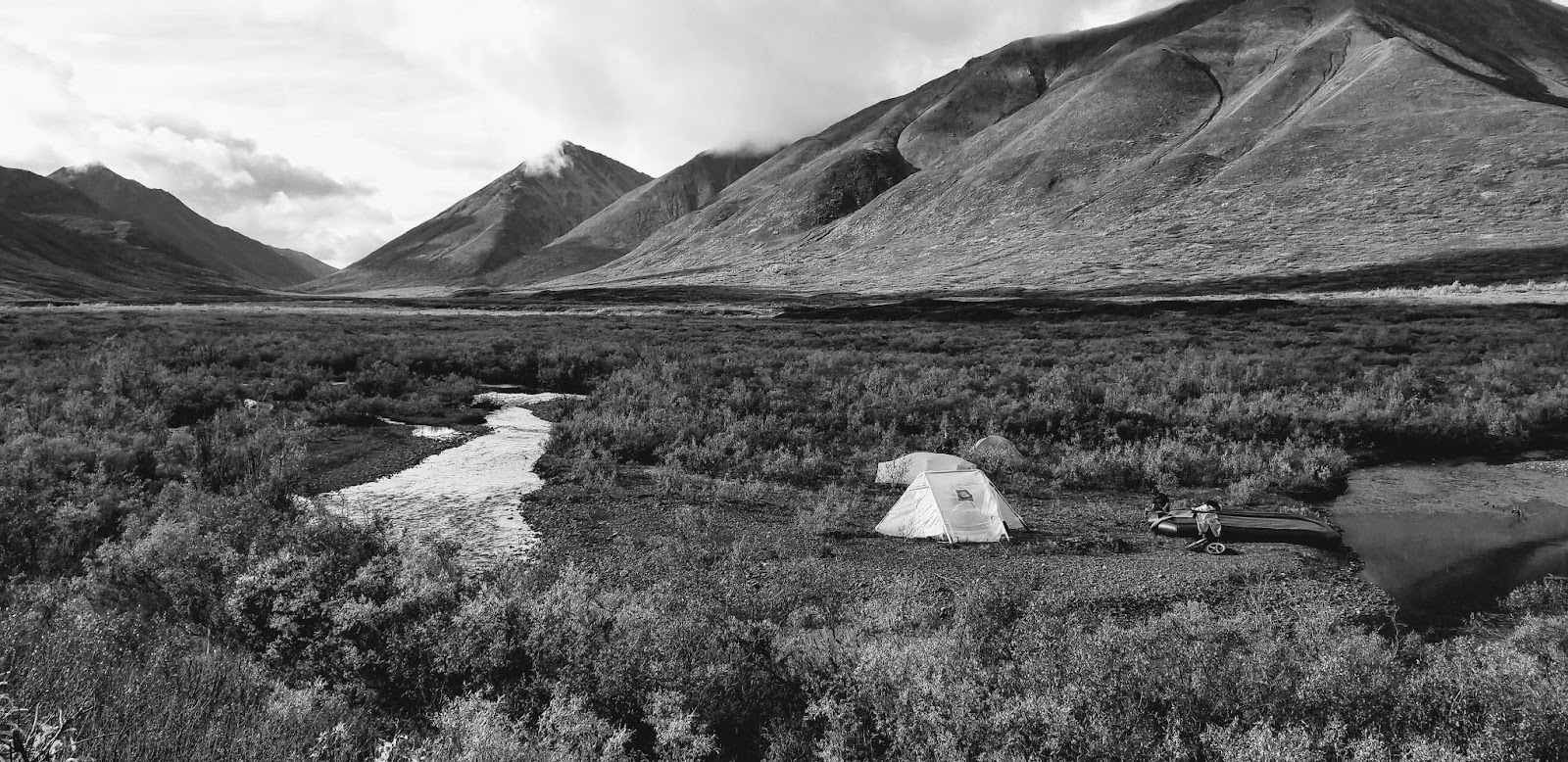


    The creek before us split into three.  The majority of the water disappeared to the right as it filtered itself through the bushes. Weird. The middle fork was clear from obstruction but wasn’t enough water for our rafts. “We go left here.” I said.  
   “Okay.” said my partner and we pushed and pulled and dragged the raft over a formidable blockade of beaver chewed branches.  The narrow and very shallow channel led to a beaver pond. I pulled on the bow as he pushed and pulled on the the stern. Although much smaller than myself, my partner was strong enough to pull his weight and wasn’t much for complaining. Perfect. Soon enough we made it to the pond.  
    The work today was easier than the two days prior.  Dragging a raft over miles of shallow and skinny water is tough but not nearly as tough as ferrying 400 pounds of gear on your back several miles and certainly not as tough as pushing a loaded cart 500 vertical feet up a steep trail.
    “I’ll paddle over to the dam.  You go back up and help your dad.”  My partner agreed and disappeared back upstream.  My nephew Keaton was not only my raft partner. He was also my cart pushing partner and tent mate.  Keaton is thirteen.
    As he disappeared back upstream, I paddled across the beaver pond until I reached the dam.  Since this was not my first rodeo, I have learned how to negotiate the dam. There is a solid eight foot drop to the creek below the dam and I knew just what to do.  After removing a few sticks the water started to flow. After several more sticks I was ready to pull the raft over the dam. There was enough water flushing over the “chute” that I’d created  allowing the raft to slide over and down to the skinny creek below. With one last pull the raft came sliding down the dam, into the creek. Pete and his two boys were halfway across the pond by now and would perform the same slide into the creek below.
    Over the years, we have established various campsites along our route that we look forward to.  Each camp is considered for it’s strategic benefits and drawbacks and although we like to have an open mind about trying new spots we usually settle on the same ol’ campsites; they are like old friends.  
   Our first camp spot is usually only a couple of bends further downstream and we were looking forward to using it again but this year would be different.  As I rounded the last corner leading to camp motion caught my eye. There, not fifty feet from me was a bear standing on his hind legs looking at me over the top of some bushes.  The snapshot image I still have in my brain from that moment resembles a lifesize honey bear; It was honey color, had rounded ears and beady eyes, and was motionless.
    I scrambled to the raft and was able to gather my .45 magnum pistol posthaste.  I turned and honey bear was gone. I would soon find out that there was a dead moose there that the bear was feeding on.  It was a scene that we have observed before. The moose carcass, barely visible now, was almost completely buried. Nearby bushes were ripped out of the ground and freshly exposed soil was piled on top of the moose.  Only the bony lower jaw was visible as we quickly escorted our rafts past the scene. I could imagine the bear aggressively scooping through its hind legs, dirt flying.
    After that I was on high-alert and felt a bit like Tom Cruise in Mission impossible, gun drawn, head on a swivel;  I joked with whole crew later at camp that I thought about doing a dive-roll into some nearby bushes for cover. Brenton, Pete’s younger son, who is eleven believed me if only for a moment; that was good enough for me.
    We continued downriver for about another mile until we felt good about our distance from the moose carcass.  This would turn-out to be a good basecamp for us and we began the process of setting up. The camp worked well and I wonder if next year we will be inclined to use it again.
Keaton took this beautiful interior grizzly.
It could be Honey Bear!?!?
      
Brenton and Keaton: Just two Alaskan boys doing Alaskan things.


Wednesday, September 5, 2018

Methodology of a Moose Hunter

Methodology of a Moose Hunter
Idiom:“Strike while the iron is hot”- To act on an opportunity while favorable conditions exist; to avoid waiting.


    7:32 A.M.  I was trying to be quiet but slogging through a swamp riddled with tussocks and muddy troughs can make for a noisy affair.  The maze of bushy tussocks pretended to offer good footing but once committed to the step, the tangle of snaggletooth bushes would give-way or trip me up. Fun.  Stepping in the troughs wasn’t any better; they were water logged and muddy sometimes testing the upper limits of my Muck boots.
    My “shortcut” through the swamp was anything but and I was beginning to doubt my decision. I stopped for a breather.  To my right, not 75 yards away was what I was looking for...or so I thought. After shouldering my 30.06 and looking through the scope I could see that it was not a bull moose staring straight at me like I was hoping.  In fact it was a dark stump with a curved antler shaped branch completing the outline....darn.  
     Almost all of my success as a moose and caribou hunter has been realized by using an entirely different method fittingly called the “spot and stalk”.  Unfortunately this particular hunting area is not above treeline where binoculars and spotting scopes can be effectively used to spot and identify legal game.  On this hunt I was hoping to fine-tune my calling technique and bring a bull out from hiding. Thus far in the last few days it was not working. It was too early in September.
     Calling moose is a fine art.  By imitating the nasally whine of a cow moose or the aggressive short grunt of a bull, it’s possible to lure bulls to close enough range for a shot.  Late in September bull moose go into rut and compete for mating rights. I have had the privilege over the years of observing many herds of over 40 moose who all show up for “the dance”.  Young bulls posture and practice fight, cows mingle and even attack each other with their front hooves, and the big bulls save their energy until a worthy opponent challenges them. Bull fights are violent affairs that are incredible to witness.  The tougher stronger bull with the right growth of antlers used as a weapon wins the fight and spends the rest of the fall rut mating with each of the cows in his “harem”. This process ensures that herd stays strong by passing along only the genes of the bull who has grown big and strong, adapted the best and prospered well through several tough winters; Survival of the fittest.
     There was a light frost on all of the grass and willow bushes this morning.  I was excited because I know that moose start to move around when it’s cold. In the two days  prior we had only seen one other moose. I saw it fleetingly and I could not determine the sex through the thick foliage.  I was lucky to have drawn an any bull tag for our game unit. Unfortunately our area is super bushy and up to this point, warm.  Moose bed down when it’s warm and don’t move around much. I needed a different strategy.
    I knew this was my last chance.  We would head down river the next morning, back to civilization.  It was nice and chilly with the morning frost, but I knew that it wouldn’t last. The sun was slowly rising and I knew that it wouldn’t  be long before it would become T-shirt weather. I looked one last time to see if my stump imposter would magically come to life. It didn’t.  I slung my rifle over my shoulder and continued across the swamp.
   7:40 A.M.  Finally I successfully traversed the swamp and popped out onto a rather nice four wheeler trail.  One of our neighbors has a 3 mile long trail to his cabin that is flanked by long stretches of moose’s favorite food; willow.  The bushes were over my head and I quickly realized that I wasn’t going to be able to spot anything. I decided to proceed down the trail in the hopes that I would run into one or scare one up that might be bedded down near the trail.
    My plan involved walking about 50 feet down the trail quietly, then pause to look and listen.  There was no wind and it was joyful to take-in the forest through my senses. I heard a woodpecker knocking a nearby cottonwood on one stop.  The next break I heard an eagle screech high above. Another stop I watched and heard a single yellow birch leaf fall and land nearby. The Alaskan outdoors is my church and on this glorious morning I was glad to be alive.
  8:03:15 A.M.  The trail was beginning to parallel a nearby glacial slough. A tall and proud army of fireweed framed the trail as the slough grew nearer.  I made my way carefully around the bend and I decided to stop before it straightened out. As I was looking around I heard a branch snap ahead of me.  I didn’t know what it was but I knew that if it happened to be a bull moose I would have to be ready. I have learned to be an opportunist in my hunting.  Any hesitation on my part could be the demise of the hunt. I have been on too many hunts when I wasn’t ready in the crux moment and the opportunity is lost.  Strike while the iron is hot.
    I quietly slipped the shoulder straps off of my pack and lowered it quietly to the ground.  Another stick snap. I jacked a shell into the chamber and carefully slid the safely to the off position.  If I spook a moose into the thickets, it will be gone from me. They are too fast and nimble to chase and the vegetation is way too thick.  I’ve got to be ready to shoot.
    8:04 A.M.   I proceded further down the trail slowly taking care to avoid any snapping sticks of my own that might give me away.  Finally, I peered around the corner. Sure enough standing just off the trail and directly in front of me was a young 2 year old bull.  Not fifty yards away I could See his small 30 inch antlers and it was all the proof I needed as I shouldered my trusty rifle. He looked up and saw me just in time to meet his demise.  Game over.
  
Hazelee with her first grouse.
Corey and Sam celebrating the harvest their own way.
Corey also shot 4 nice mallards on the last day.
Although I'm not sure if these mushrooms are edible, my brother
and his boy Brenton each found Chicken of the Woods.  We ate some as appetizers
(sauteed in butter), the rest we added to an already incredible spaghetti sauce
prepared by my dad.
The blue rope on the right is a rope ratchet.  It comes in handy
gutting a moose by yourself.

Keaton and I spent our first morning canoeing to this spot on top of a beaver lodge. We called but saw nothing.


Saturday, July 28, 2018

2018 Silverbright Championships

2018 Silverbright Championships
Steve Sr. taking care of business
“You ready to get your ass kicked again?” She asked.  Jamie is not known for her subtleties.  
      “What do you mean?”, I said.  She was over at our place picking up some salmon.  We have a setnet operation at the mouth of the Susitna River and we bring all of our fish home and sell them right out of our driveway to locals. 
      “Battle of the Silverbrights!”  She said.  Suddenly I understood.  Last year I challenged her to a smoked salmon competition. Smoked chum to be specific. I lost.  Who knew that she would bust out the ghost peppers to kick-it-up a notch. 
      Chum salmon are known by many other names; Dogs, Arctic Keta, Calico and my favorite Silverbright.  They are huge fish and have lots of oily fat on their belly which, as it turns out is great for smoking. 
     The majority of our customers are Alaskans who appreciate the resource but are increasingly unexcited about the prospect of driving to the Peninsula to try their hand with hundreds of other anglers or dipnetters.  Their other option is waiting for the fish to make it North to local streams where they are sometimes battle hardened and starting to turn blush.  For a lot of our customers it's a matter of dollars and cents.  They realize that for what it cost to take time off from work, pay for gas and supplies for a weekend of fishing on the Kenai, they are far better off pulling in to our driveway to buy a few beauties from us in prime condition-right out of the ocean.
     “Okay, it’s on!” I felt myself becoming excited.  The sudden need for redemption overcame me as foolishly exclaimed, “You’re going down this year!”
       The next fishing period we only caught six of them and a few of them were already spoken for.  I saved the last one and fileted it proper.  I put hers on ice in a small cooler out front.  The next morning after coffee, I checked the cooler and the big slab of fish was gone. Game on! A smile came over me because I knew that the stage was now set for the 2018 Silverbright Championships.

This year's offering.  I could tell you the recipe
but then I would have to kill you....sorry.

Wednesday, January 31, 2018

Fresh Winter Bird

Fresh Winter Bird
On the way to the cabin
     “Oh my God, what is that?”, I thought. I reached into the icy water to pull the trap upwards and suddenly it was clear; I had caught a duck.  The underwater trap destined for otter was baited with freezer-burned salmon.  Who knew that a large green-head mallard would be enticed by such an offering.  The cold, clearwater stream trickled-by releasing steam near its edges.  It was 10 below zero and the flow of the stream was keeping it from freezing.  I took a good look at the duck. “Trapper of the year.” I joked.
    I pried the 330 conibear apart with Bryan’s help and handed him the duck.  “Wow, nice work.” he said.  This year, like most years, I had purchased a state and federal duck stamp allowing me to legally shoot waterfowl including ducks, geese, and even cranes.  They were all safe from me though; This year I had killed exactly zero....until now.   Who needs a shotgun?

      Trapping season has been slow but  I have managed to catch three beautiful crossfoxes and a mink for all of my efforts. One thing is for sure; I have a lot to learn.  
    “Hey Dad, see if you can guess what I caught in my otter trap yesterday.”  Bryan and I had joined Dad at the cabin a few days after the duck by-catch incident and were looking forward to a good weekend.
    “Otter?”
    “Nope, its something we are going to eat.”
    “Pike?”
    “Nope.” The guessing went on like this for a while.  After a few more hints he finally guessed duck.  At this point, I produced a ziplock bag containing the breasts of the duck that I had butchered with the skin on.  I had it marinading in a balsamic vinegrette for the last day.  Duck is notorious for having a gamy flavor.  I assumed that a mid-winter fish eating duck might be especially so.   
    “Hey Steve, come here!”  Bryan was facing the shed.  “There’s a grouse in the shed.”  I scurried over to my snowmachine to fetch my pistol.  To my delight, sure enough he was right;  a plump grouse was milling around inside the shed.  It felt a little wrong shooting a firearm into the shed but my aim was true and suddenly we were up to two birds for dinner.  
      Later in the day Bryan pulled around the cabin on his snowmachine and another grouse flushed up behind him.“Hey Bryan, freeze right there!”   It darted straight up into a high spruce tree.  “Your turn.”, I said.  I fished out the pistol and handed it over.  The bird was perched some 50 feet high in a tall spruce tree.
    Side note: Last weekend Bryan and I spent some time honing our pistol shooting skills at the cabin. I’ve got a series of old cooking pans dangling from an overhanging birch tree.  We shot over 70 rounds of .22 shells.  I’m a firm believer that if you want to be an accurate pistol shooter then you have to shoot a lot.
     Bryan steadied his arm and slowly squeezed the trigger.  The bird twitched and twirled as it took off from it’s branch.  As it flew, it was easy to see that it was wounded and it soon took perch on a different tree.  We watched as it flopped and dropped down to lower branches until finally it fell to the ground; Tonight we would dine on 3 birds for dinner.  


Grouse and Duck in Red Wine Vinegar  
(Original recipe was taken from geniouskitchen.com but uses chicken....  bo-ring!)    

Ingredients:

1 free-range mallard duck (breast meat diced with skin on)
2 free-range spruce grouse (breast meat diced without skin)
1 cup red wine vinegar
1 cup chicken stock
2  red ripe tomatoes
2 spoons olive oil
1 tbsp fresh parsley
4 tablespoons butter

Directions:

1) Brown the marinated duck and grouse in the butter with a bit of oil as well to stop it burning.
2) Drain fat from skillet and return the poultry to skillet.
3) Slowly pour the vinegar into the hot pan to deglaze. Stand back from fumes!
4) Over med-high heat, reduce the vinegar by about half, turning the poultry periodically to bathe it.
5) Add tomatoes and stock, cover and simmer gently until flavors have melded and mingled, about 20 minutes.  Remove the pan from heat, set aside the poultry and keep warm.
6) In the pan, whisk in a knob of butter for a beautiful shiny sauce.
Pour the sauce over the poultry and then strew with herbs.
7) Enjoy with egg noodles. 

Sunday, November 12, 2017

The Salmon's Gift


The Salmon’s Gift


“Ain’t no sunshine when she’s gone...”-Bill Withers


    It was frozen into the top of the beaver dam.  The blood on the snow was fresh.  The tracks of fox, coyote, and otter concentrated around the perimeters of the pool packing down the snow. I felt like I was walking up onto a murder scene.
     Down below the dam, in the clear, deep pool were the last of his troop.  There were about fifty of them still alive mindlessly swaying in the current.  It’s mid November in Alaska and if you are a salmon that happens to still be alive then one thing is for sure; you are living on borrowed time.
       The swimmers, still marginally wary, darted from my reflection.  An attempt at a cursory escape, their efforts were futile.  They turned in unison making their way to the other side of the pool.   This pool, the size of a tennis court was thwarted by a ten foot-tall beaver dam.  They were at the end of the line.
     A few of their fallen brethren were scattered about on the bottom of the pool.  They bodies had run their course and were motionless in various positions; One was on its side, another belly up.  The process of decay had already begun and I was sure that it wouldn’t be long before they were gone altogether.  But then again, I know better.
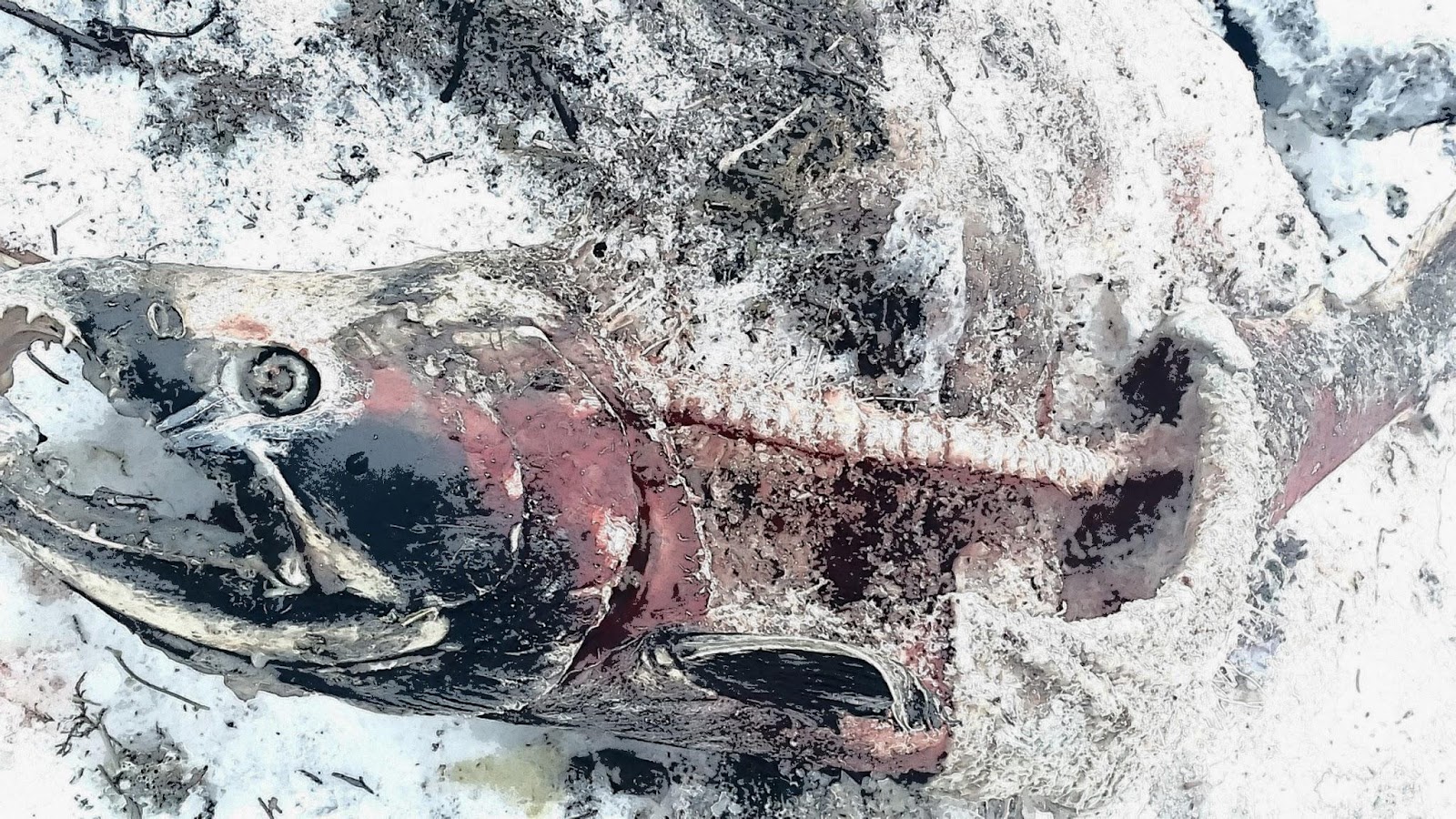
    When salmon push up into their native streams to spawn, they bring with them all of the nutrients they have accumulated in their 2 to 7 years in the ocean.  When they die these same nutrients get re-distributed to a wide variety of organisms.  According to ADFG, researchers have found that salmon provide food for at least 137 different species of microbes, stream invertebrates, mammals and birds.
    Coowe Walker, who is a program Watershed Ecologist for the University of Alaska believes that these “salmon-derived” nutrients are important to the health of stream ecosystems, and especially to the growth and development of young fish. Circle of life? (Cue Lion King soundtrack)
   The trees, and plants utilize the nutrients from the salmon.  In return the trees and plants provide ideal habitat for spawning salmon ensuring the survival of juvenile salmon.  
  I couldn’t stop thinking about the future of this very salmon stream.  It makes me feel so small to realize that, since so many salmon are spawning this year it cannot be by accident.  One hundred years ago, conditions were just right.  Three hundred years ago...same.  How far back have conditions been favorable for salmon in this very stream so that in 2017 there are at least 50 fish swaying in the current so high in the river’s system on November 11th?
     I cannot ignore what I have learned by paying attention to the History of Salmon.  Europe, England, the East and West Coast of America once all had great salmon runs like we have in Alaska now. One by one big-industry, over-development and overfishing have decimated these runs.
     If history is any indication then we are next.  Alaska remains the last stronghold of salmon super-abundance.  As a commercial fisherman in Cook Inlet and Bristol Bay I have seen it first hand.  We are living in the glory days of giant runs of salmon.
    So how do we proceed?  The answer to this question is so simple it’s maddening.  Don’t screw it up.  Don’t kill too many of them, (Thank you board of Fish and ADFG) and equally as important; don’t destroy their habitat.  These are the two big lessons.
    All we have to do is learn from history.  If we don’t then we’ll have to settle for longingly reflecting about how it used to be.   Can you imagine an Alaska without Salmon?
Hazelee helping with our families setnet operation.
    I’m pro-development of Alaska’s resources but I realize that it’s not smart to trade one resource for another.  What would happen if coal, or natural gas, or a damming project were pursued in this stream valley before me? Who knows?
     Existing statutes on development in sensitive salmon streams have not been updated since statehood and are putting our salmon at risk.  Already we have had fend off the ridiculously irresponsible Pebble mine and Susitna-Watana Dam projects that science and history tells us would destroy huge salmon watersheds.  There needs to be agreed-upon criteria to protect salmon streams.  We can’t trust the whims of the latest gubernatorial administration to do the right thing.
    I was slow to leave this incredible scene and as I started to wade across the creek I stopped in my tracks.   There, in the middle of the stream swirling in an eddy were a hundred-or-so salmon eggs.  Some were partially buried, but some of them were adrift in the current.  “Are these fertilized eggs?”, I wondered.  I slowly backed up.  I decided instead to cross over the beaver dam.  

Monday, October 23, 2017

Caribou Hunting with a Hot Tent

 Caribou Hunting with a Hot Tent
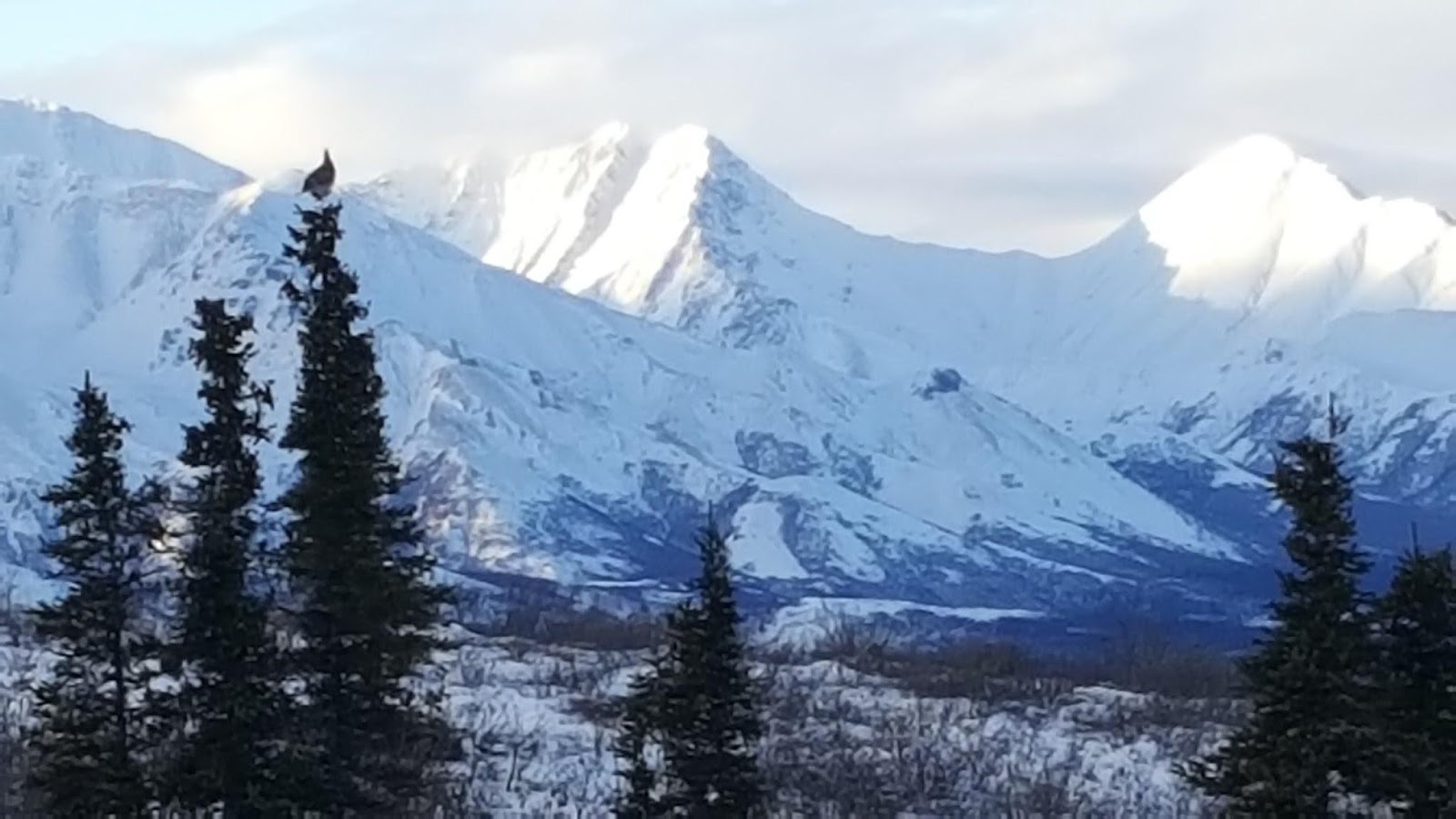
20171022_102207.jpg     -Mystery bird perching on spruce.


     I bought a camping wood stove last Spring called the Titanium Goat.   The main selling point for me was weight; 1 pound 6 ounces for the  wood stove and the stovepipe,...not bad.   I wanted to add some much needed dry heat to our moose hunting shelter.   There have been many years on our hunt when it has rained, snowed or rained and snowed every single day of the trip.  I was hoping to be able to dry clothing and warm our bones.
    Since we hunt in a non-motorized area weight is always a judicious consideration.  In my mind the less-than two pound burden of the stove was so insignificant that it was worth fussing-with and even modifying gear as needed to make room for such a potentially game-changing piece.  
Our moose hunting shelter.  The Titanium goat was
underpowered to heat this behemoth.
   Although it was a little underpowered for our large moose hunting shelter, I knew that my tiny little Titanium Goat wood stove had its place and I really wanted to bask in the glow of it’s warm embers.  It would be especially grand if it were particularly inhospitable outside.  


Maybe I could modify my tent.  


    “I think I want to go hunting this weekend”.  I said.  Tamra wasn’t sure what I was talking about.  “The Nelchina caribou hunt closed on Sept 30th for the rut but it opens back up on October 21st.”
    “Okay.”, she said.   
      I began the process of designing a rain fly stovepipe adapter so I could use my wood stove inside my dome tent.  With only two days before I wanted to leave, I began the design process after work. I set up the tent on my frozen lawn.  
1/8 inch aluminum and random hardware found
in my garage would help to separate flammable tent material
from the hot stove pipe.
At this point there were puzzled looks from the wife.  Upon completion,  I snugged it into place on the rain fly zipper.  I crawled into the tent from the other side and fired up the stove.  I knew that if the tent smoldered, melted or erupt into dancing flames, it would be a failure and I wanted to find that out in the comforts of my back yard, not in the wilderness several miles from the truck.  Luckily none of these things happened.  What did happen was the inside of the tent warmed up quickly and life was good.  I dubbed it Prototype “A”.  It was almost as heavy as the whole stove but it worked, at least on my lawn.  
    The weather forecast for Cantwell Alaska was clear and cold.  How cold I wasn’t sure.  At this same time last year it was below zero.   My gear was packed; I was ready.
    I wanted to take my fat tire bike and cart but the snow was just a little too deep.  I opted instead to hike in and pull a plastic sled.  I had both loaded in the truck so I would have some flexibility.  The orange Paris sled has been with me on many mountain trips and it’s a blessing to be able to get weight off of your back.
hiking in.
     I split the weight of my camp and hunting kit between my pack and the sled and set off up the trail.  It was five degrees Fahrenheit when I left the truck but I had a good pace and was able to stay warm without sweating too much.  Before long I set up my camp about five miles-in at a place that, over the years, we have named “Caribou camp”.  I wanted to get the most use of the dwindling daylight hours so I didn’t set up camp right away like I usually do.  I dumped all unnecessary gear and headed further up the trail.  After about an hour I spotted a couple of small caribou grazing in the valley below.  
   The biologists at The Alaska Department of Fish and Game (ADFG) have been encouraging folks to harvest cows because the herd is exceptionally strong right now and they are worried that they will overgraze their habitat which, in- turn could cause a dramatic crash in the herd.  In fact, last year they granted a second permit for any tier 1 Nelchina caribou permit holder to help achieve this goal.  I wanted to bag a cow but I’m an opportunistic hunter; I’m not likely to pass up legal game. Know thyself.
     I continued down the trail, making myself small trying to avoid giving away my position.  I hunkered low as I made my way down the hill toward the cows.  Something caught my eye.  “Oh shit, there’s a big bull!” I noticed.  The bull had been laying low below a small bench.  When he saw me sneaking down the hill, he stood up, looked at me and then ran off.  Quickly I took off my pack, chambered a round in my 30.06 and waited for my opportunity.  

    Sure enough he appeared in a small clearing between stands of Willow bushes about 300 yards away.  He took pause to turn and look at me and as it turned out this was his last mistake.  

Bull down
After one antler broke off, I used it to anchor
my rope ratchet to hoist the rear leg.
All of the meat fit into my
kiddy sled.
Titanium goat kicking ass.
Hauling meat six miles to truck is a lot easier
with a sled and a few down hills runs.


Sunday, October 15, 2017

Peddle Paddle

Peddle Paddle


    I have been experimenting with bike-rafting.  The idea is not hard to understand; bike with a packraft to a destination with water.  From there  float home or elsewhere with the bike cleverly strapped onto the raft.  Voila!  
    In the end it’s a lot of set-up/ breakdown but the great thing about bikerafting is that you get to ride your bike, paddle your raft, and see some fantastic country that wouldn’t be accessible otherwise.  
    The plan was to peddle my bike and gear from the town of Talkeetna, up the tracks and overland to Clear Creek.  From there I would break-down the bike and strap it to my pack raft.  With a little fly fishing along the way and a sparkle in my eye, I would float back to Talkeetna.  I’ve pack rafted the route two other times (hiking-in) with friends and thought that adding a bike to the equation would be faster and more challenging.
  It was 23 degrees F. when I left at 7:30 A.M.  I made good time and before long I found myself at the gravel pit 5 miles in.   I started up the hill, but  suddenly my pace slowed to that of a small tortoise.
   “Shit” I thought.  In front of me I saw that the trail was completely submerged.  It had rained hard last week.  The last two days were clear and cold.  The result of these two weather events was lots of standing water on the trail.  I tried to ride through it. The thin layer of ice held my weight for a few feet but then I would crash through, into the mud puddle.
One of many long runs of
standing water on the trail
to Clear Creek. Oct 15th 2017
I decided to push my bike through it while I skirted to the side.  This made for a trying effort because there wasn’t much room to skirt.  I bushwhacked and sidestepped my way to the other side.  A brief “dry” section brought me to the next pond.  With one hand on the seat, the other on the handlebar I leaned into the bike and danced along the bank.  The ice broke off in plates in front of the bike.  I could see another long stretch of water around the corner.   After 45 minutes of this with no end in sight, I had an epiphany;  This sucks!  
    I decided that I wasn’t willing to spend my entire day thrashing through muddy troughs with my bike when I would be much better served with a gondola or canoe.  Having already biked six miles, I realized that I had another ten miles to go to reach Clear Creek and after scouting further down the trail (without my bike) I discovered more of the same.

    I retreated back through the slop and down to the railroad tracks.  I headed North up the tracks with a new plan.  I would drop into the Susitna River and float back that way.  After a few miles of riding on the tracks the River came into view and I knew that this would be a good day.
Let the breakdown begin.  I removed both tires
and lashed everything down
Denali was my companion all day.
Almost home near the confluence of the three rivers;
The Susitna, the Chulitna, and the Talkeetna.